


What are varicose veins?
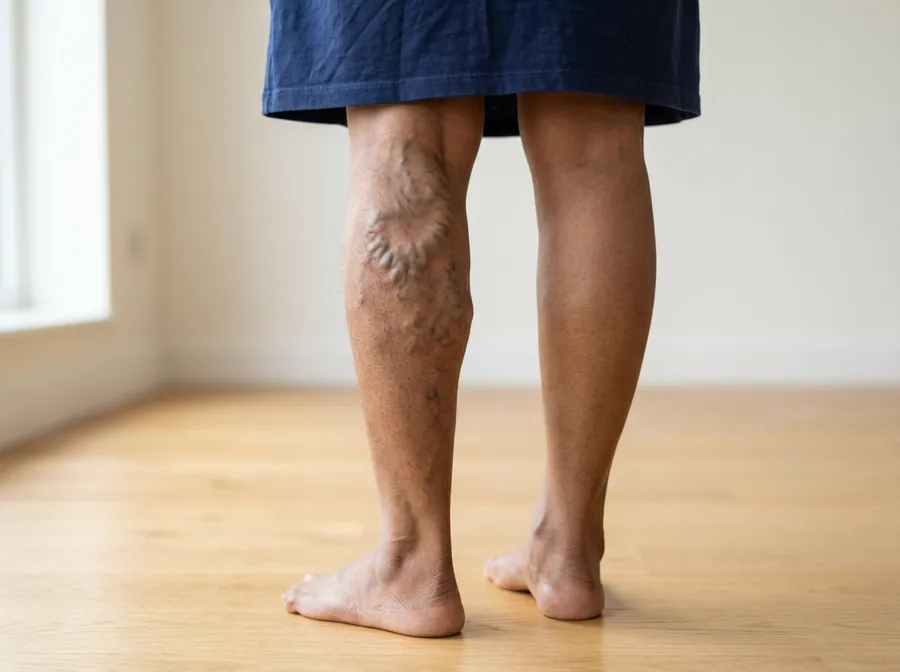
Varicose veins are swollen, twisted veins that bulge under the skin, usually on the calf or the inner side of the thigh. Leg veins have small one-way valves that keep blood moving up towards the heart. When these valves weaken, blood falls back down and pools, and the veins stretch over time.
Risk factors include family history, pregnancy, age, extra weight and jobs that keep you standing for hours, such as teaching, retail or security work.
Doctors grade venous disease in stages (the CEAP classification). In plain words, it usually progresses like this:
- Spider and thread veins: fine red or blue lines, mostly a cosmetic concern.
- Varicose veins: rope-like veins wider than about 3 mm, with or without aching.
- Swelling: ankles that puff up by evening and settle overnight.
- Skin changes: itching, eczema, brown or dark patches near the ankle, or hard, tight skin.
- Ulcers: an open sore near the ankle that is slow to heal, or one that has healed and left a scar.
Typical symptoms are heaviness, aching, throbbing, night cramps and restless legs, often worse at the end of a long day or in hot weather.
When should you see a surgeon?
If your veins are purely cosmetic and cause no discomfort, treatment is a choice, not a necessity, and it is reasonable to wait. For a fuller guide, read varicose veins: when to worry.
See a surgeon if you have:
- Aching, heaviness or swelling that affects work, sleep or walking
- Itching, eczema or darkening of the skin around the ankle
- A wound near the ankle, healed or open
- A hard, red, tender cord along a vein (superficial thrombophlebitis)
- Bleeding from a varicose vein, even once
- Veins that have come back after earlier treatment
Diagnosis: the venous Doppler scan
The consultation starts with your story: your symptoms, work, pregnancies and any past clot. Dr. Sanjit Gogoi then examines both legs while you stand, because varicose veins fill and show clearly in that position.
The key test is a venous Doppler (duplex) ultrasound. It is a simple, non-invasive scan, done standing, with no injection or radiation. It shows:
- Which veins are leaking, usually the great saphenous vein along the inner thigh and leg, or the small saphenous vein behind the calf
- Where the leak starts, for example at the groin or behind the knee
- The width and course of each vein, which decides whether laser or glue is suitable
- Whether the deep veins are open and working, which matters before any treatment
Dr. Sanjit walks you through the scan in simple language, shows you which vein is the problem, and explains each option with its pros and cons.
Treatment options for varicose veins
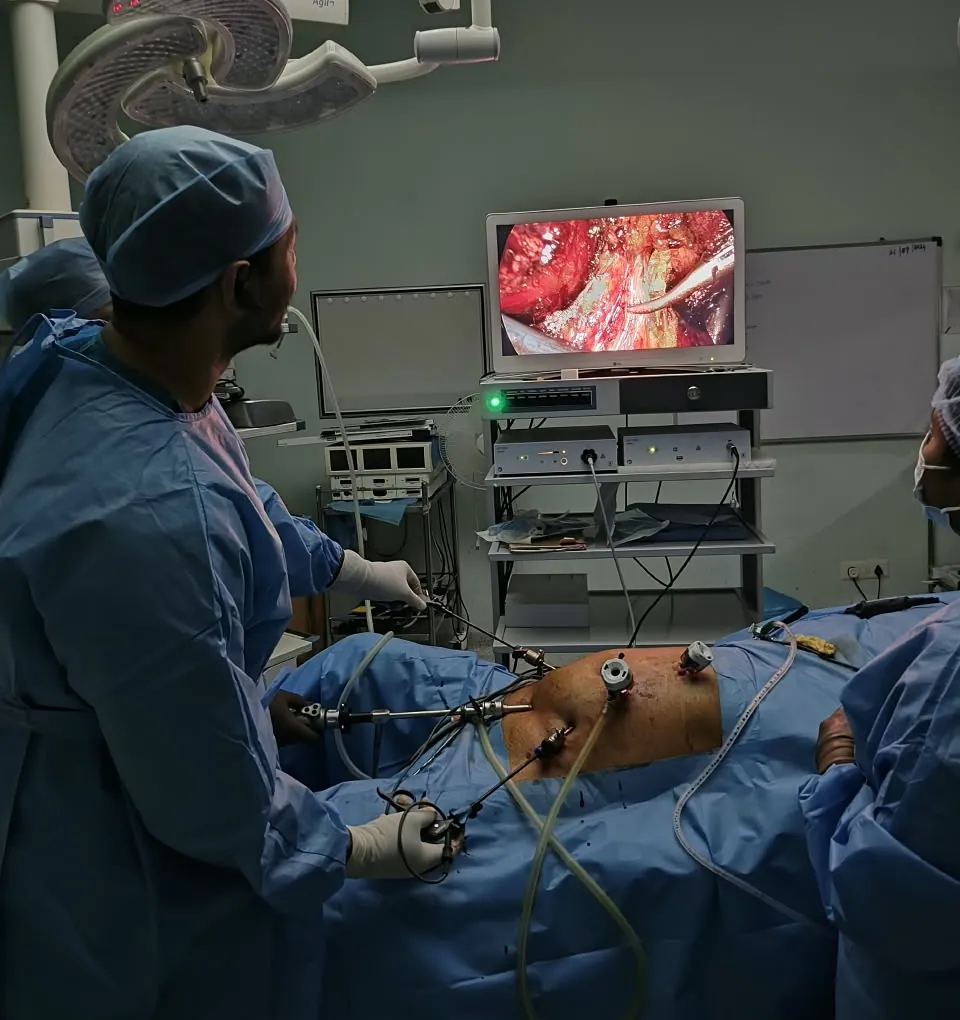
International guidelines, including those from NICE in the UK, recommend treating symptomatic varicose veins from inside the vein (endovenous treatment) as the first choice for most patients, with foam sclerotherapy and open surgery as alternatives when endovenous treatment is not suitable. Like laparoscopic surgery, these are minimal access methods. The right plan depends on your scan.
Compression stockings and lifestyle
Graduated compression stockings ease aching and swelling, and help during pregnancy or when someone is not fit for a procedure. They do not close the leaking vein, so symptoms usually return when you stop. Walking, calf exercises and raising your legs in the evening also help.
Endovenous laser ablation (EVLA)
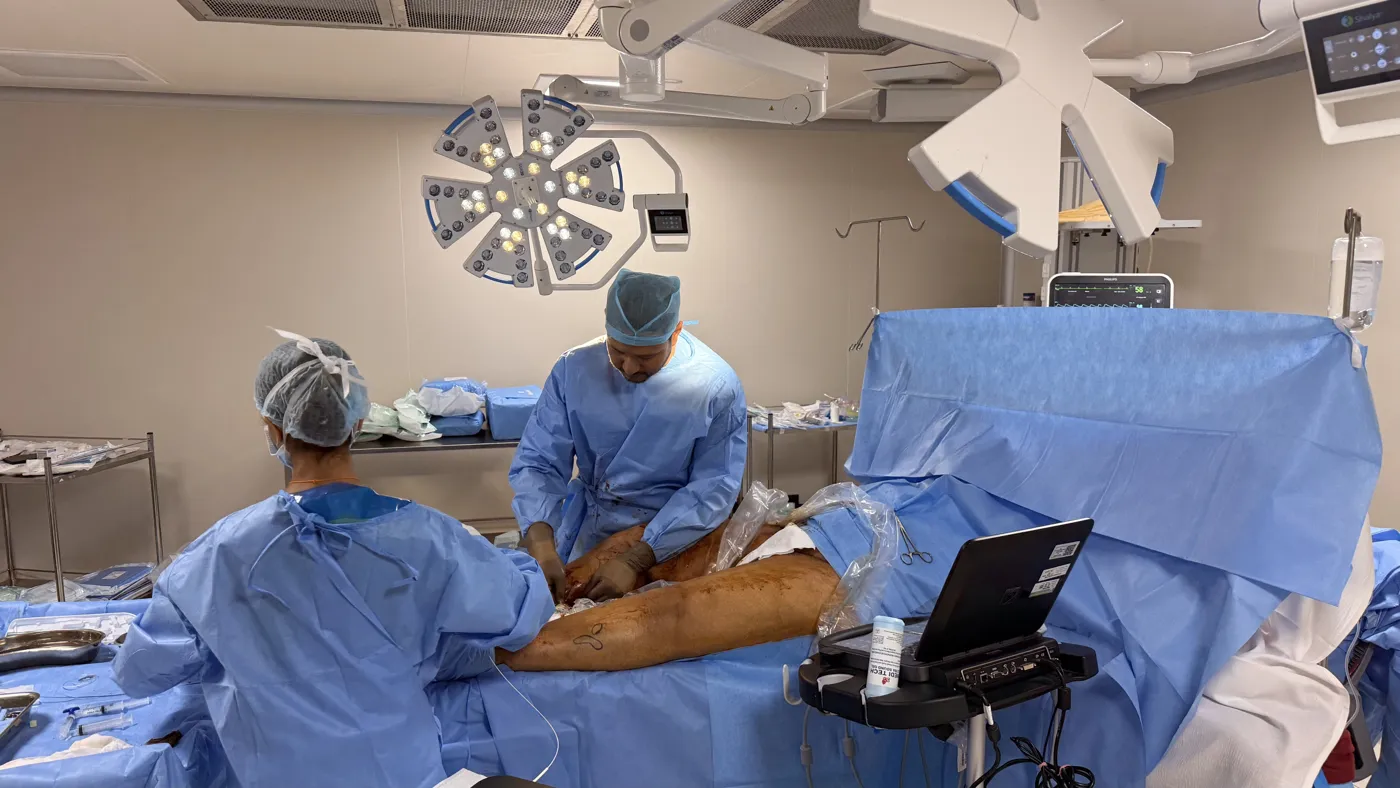
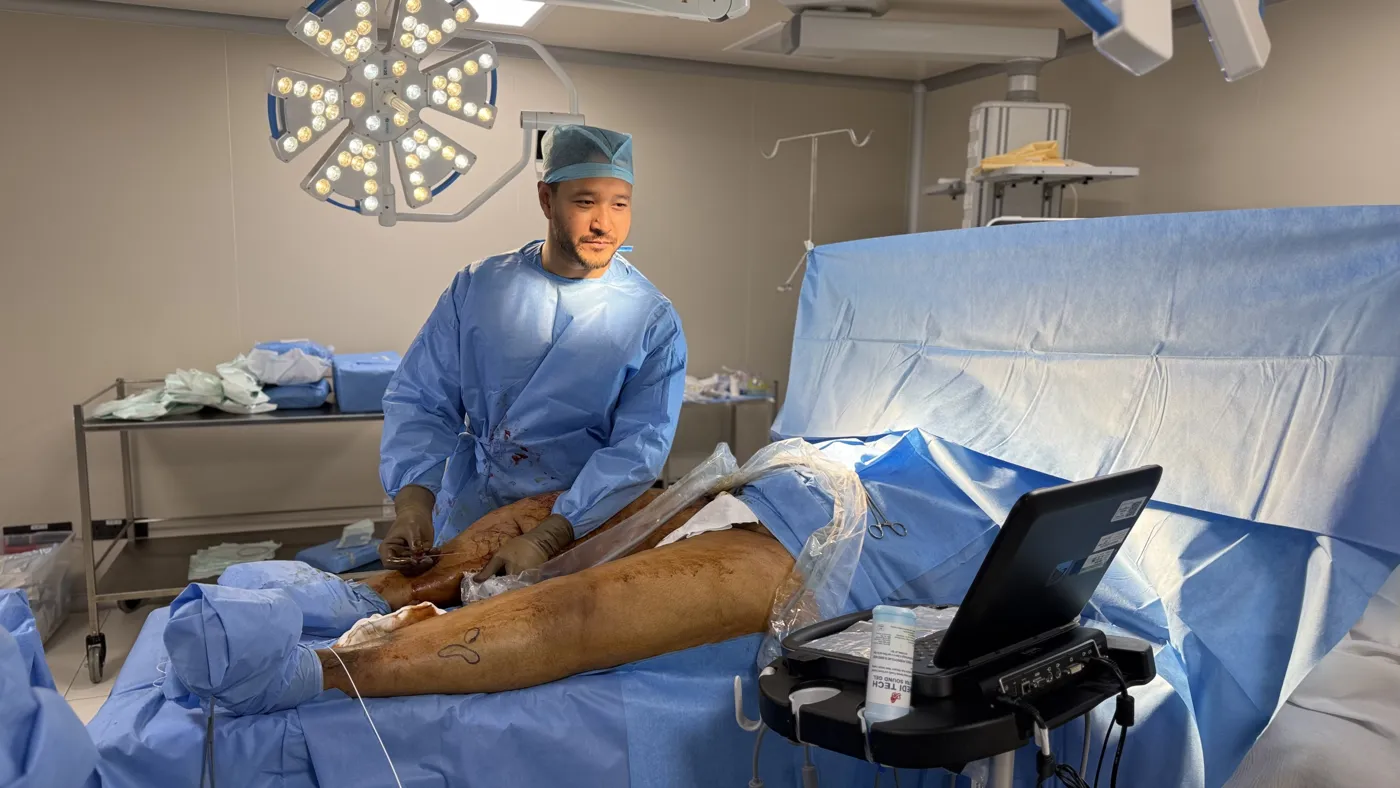
A thin laser fibre is passed into the faulty vein through a needle puncture, guided by ultrasound. Heat from the laser seals the vein shut from inside, and blood reroutes through healthy veins. It is done under local anaesthetic, usually as day care.
Cyanoacrylate glue closure
A medical-grade glue (VenaSeal-type cyanoacrylate) is placed inside the vein through a fine catheter to seal it. Because no heat is used, the numbing injections along the vein are not needed, and many patients do not need stockings afterwards. It suits most people, but not anyone with a known allergy to cyanoacrylate or similar adhesives.
Foam sclerotherapy for residual veins
After the main vein is closed, side branches often shrink on their own. Any that remain can be closed with a foam injection through a fine needle, usually without admission. Some patients need more than one session.
Open surgery (ligation and stripping)
The traditional operation ties off the vein at the groin and removes it through small cuts, under spinal or general anaesthesia. It is now rarely needed, but remains an option for veins that are very twisted or too wide for laser or glue.
Varicocele: another venous problem
A varicocele is a cluster of enlarged veins in the scrotum that can cause a dull, dragging ache. Dr. Sanjit also performs varicocele surgery. If this is your concern, book a consultation to discuss whether surgery is needed.
How EVLA and glue treatment are done
- Before: the vein is mapped and marked on the skin with ultrasound. Fasting instructions depend on whether sedation is planned.
- Numbing: the skin over the entry point, often near the knee or lower calf, is numbed with local anaesthetic.
- Access: a needle and a thin sheath are placed into the vein under ultrasound. You feel a small prick.
- Laser: for EVLA, the fibre tip is positioned just short of the junction with the deep vein, and dilute local anaesthetic (tumescent fluid) is injected around the vein to numb it and protect the surrounding tissue. The fibre is then slowly withdrawn while it seals the vein.
- Glue: for glue closure, small amounts of glue are placed along the vein while it is pressed shut with the ultrasound probe. No tumescent injections are needed.
- Side branches: bulging branches may be treated in the same sitting with foam or tiny nicks (phlebectomy), or later if they persist.
- After: a dressing goes on, and after EVLA usually a compression stocking or bandage. You walk before going home.
Treating one leg usually takes about 30 to 60 minutes. Most patients go home the same day, though the plan depends on your health and whether both legs are treated.
Recovery: what to expect
| When | What most patients can do |
|---|---|
| Same day | Walk around and go home. Short, regular walks help. |
| Days 1–3 | Return to desk work and light routine. Mild soreness is eased by simple painkillers. |
| Weeks 1–2 | A pulling or tight feeling along the treated vein and some bruising are common, often peaking around days 5–10. Wear stockings if advised. |
| Review visit | A follow-up scan confirms the vein is closed and the deep veins are clear. |
| Weeks 2–4 | Gym, running and long flights are usually resumed, as per your written plan. |
| Weeks 6–12 | The treated vein softens and fades. Remaining branches are reviewed for foam if needed. |
On long drives or flights in the first weeks, get up and walk and keep the calves moving. Most people can ride a two-wheeler within a few days, once they can brake firmly.
Risks and how they are reduced
Studies report that serious complications of endovenous treatment are uncommon, but no procedure is free of risk. Possible problems include:
- Bruising, tightness and soreness along the vein, which usually settle within two weeks.
- Inflammation of the vein (phlebitis): a red, tender cord that settles with anti-inflammatory tablets. It can occur after laser or glue.
- Numbness or tingling from irritation of a nearby nerve, more often below the knee, usually improving over months.
- Brown staining of the skin over treated veins, mostly after foam, which fades slowly.
- Blood clots extending into a deep vein, or a DVT, which are rare. The follow-up scan is there to check for this.
- Allergic reaction to glue or local anaesthetic, which is uncommon.
- New varicose veins over the years, because the tendency to weak valves remains. This can happen after any method.
Risks are reduced by a careful scan before treatment, accurate ultrasound guidance during it, early walking, and a review scan afterwards.
Why patients from Sarjapur Road, HSR and Bellandur see Dr. Sanjit
Dr. Sanjit holds an MS in General Surgery and the MRCS from the Royal College of Surgeons of Edinburgh. Venous surgery, including EVLA, glue closure and varicocele surgery, is a regular part of his work across about 18 years in general, laparoscopic and laser surgery.
He walks you through your Doppler scan, explains which vein is leaking and why a particular option suits your leg, and stays reachable by phone while you recover. Procedures are done at SPARSH Hospital, Sarjapur Road, where he consults from 10 am to 5 pm. From 5 pm to 8 pm he sees patients at his evening clinic in Doddakannelli, which helps if you work on the Outer Ring Road. Directions are on the Sarjapur Road, HSR Layout and Bellandur pages.
Cost of varicose vein treatment in Bangalore
The cost depends mainly on the method (laser or glue), whether one or both legs are treated, the number of veins, the hospital and the room category. The glue kit is a large part of the cost of glue closure. See the varicose veins treatment cost page for indicative ranges, or share your Doppler report for an estimate.
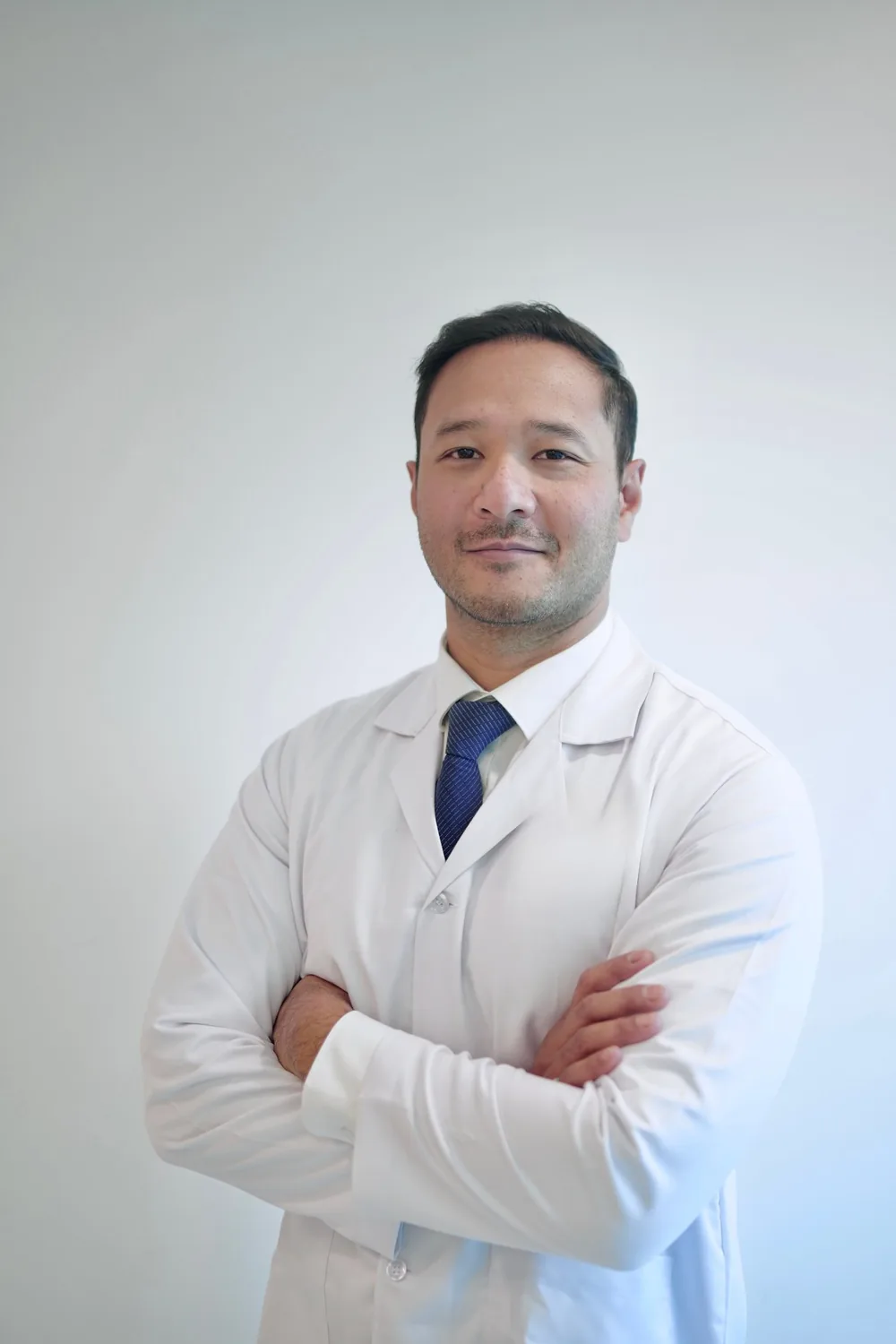
MBBS, MS (General Surgery), MRCS (Edinburgh). General and Minimal Access Surgeon with about 18 years in general, laparoscopic and laser surgery. Consults at SPARSH Hospital, Sarjapur Road (10 am – 5 pm) and his evening clinic in Doddakannelli (5 – 8 pm). KMC Reg. No. 96096. More about Dr. Sanjit