


What is laparoscopic surgery?
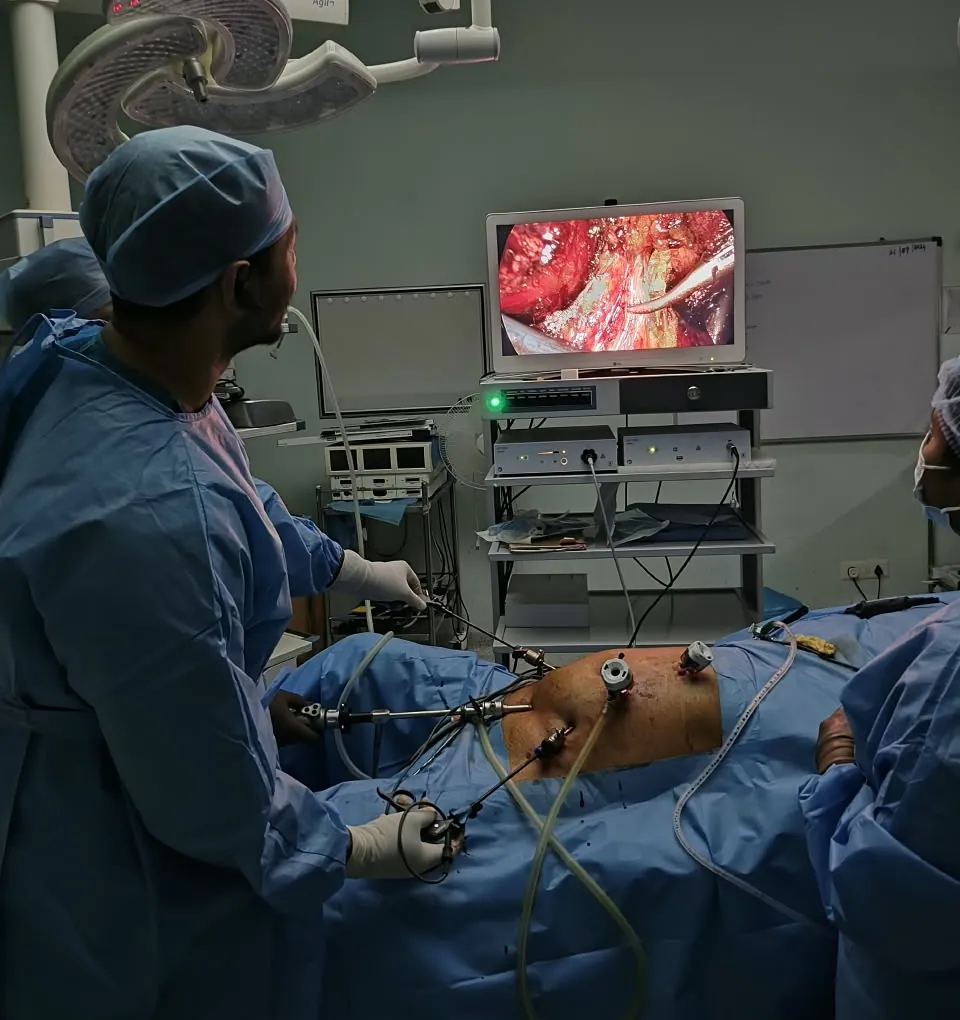
Laparoscopic surgery, also called keyhole or minimal access surgery, is a way of operating inside the abdomen through a few small cuts instead of one long incision. The surgeon works with a thin telescope camera and long, slim instruments while watching a magnified view on a high-definition screen.
The operation done inside is usually the same as in open surgery: a hernia is repaired with mesh, or a gallbladder or appendix is removed. What changes is the way in, and that mainly changes the recovery.
Dr. Sanjit Gogoi has about 18 years of experience in general, laparoscopic and laser surgery, and has mentored more than 50 young surgeons in minimal access technique.
How keyhole surgery works
- Ports: small tubes (trocars), usually 5 to 12 mm wide, are placed through tiny cuts in the abdominal wall. One is often at the belly button.
- Carbon dioxide gas: the abdomen is gently inflated with CO2 to lift the abdominal wall away from the organs and create working space. CO2 is used because the body absorbs and breathes it out easily. The pressure is kept within safe limits and monitored throughout.
- Camera: a laparoscope, a telescope with a light source, passes through one port and connects to a camera, giving a magnified, well-lit view on the screen.
- Instruments: graspers, scissors, energy devices that seal blood vessels, clips and staplers pass through the other ports.
- At the end: any tissue removed is taken out in a bag through a port, the gas is let out, and the cuts are closed with dissolving stitches or skin glue.
For some groin hernia repairs (the TEP technique), the surgeon works within the layers of the abdominal wall rather than inside the abdominal cavity, using the same camera and ports. Almost all laparoscopic operations are done under general anaesthesia.
Benefits and limits
Benefits for most patients
- Small scars, usually a few marks of 5 to 12 mm
- Less pain after surgery and less need for strong painkillers
- A shorter hospital stay, often day care or one night
- An earlier return to work, driving and daily routine
- A lower risk of wound infection and of hernia at the incision than with a long cut
- A magnified view of fine structures, and the chance to inspect the whole abdomen
Limits and specific risks
- It needs general anaesthesia, and the gas pressure puts some extra load on the heart and lungs
- Shoulder-tip pain for a day or two, from the gas irritating the diaphragm
- Rare injury to bowel or blood vessels while the first port is placed, reduced by careful entry technique
- Port-site hernia, uncommon, mainly at the belly button
- Some operations take longer than the open version, and the equipment adds cost
- Conversion to open surgery, if the view is poor, there is bleeding, or scar tissue makes it unsafe. This is a safety decision, not a failure.
Who is suitable, and who may not be
Most adults and children who need hernia repair, gallbladder removal or appendicectomy can have the operation laparoscopically, including many older patients and people with well-controlled diabetes or blood pressure.
Laparoscopy may be unsuitable, or need extra care and planning, in people with:
- Severe heart or lung disease that makes the gas or anaesthesia risky
- Several previous abdominal operations with dense scar tissue (adhesions)
- Bleeding problems, or blood thinners that cannot be paused safely
- Very large or complex hernias, where an open or combined approach may be more suitable
- Late pregnancy, where port positions and timing need special planning
- Widespread infection in the abdomen in a patient who is very unwell
Dr. Sanjit reviews your scans, your health and any previous surgery, recommends the approach he considers safest for you, and explains the alternatives.
Preparing for keyhole surgery
Before surgery you will have routine blood tests and, depending on age and health, an ECG or a physician review. Tell the team about every medicine you take, especially blood thinners and diabetes tablets or insulin, as some need to be paused or adjusted. You will be asked not to eat for about six hours beforehand, as your anaesthetist advises. Stopping smoking, even a few weeks earlier, helps your lungs and wound healing.
Operations Dr. Sanjit performs laparoscopically
- Hernia repair: mesh repair of inguinal (groin) hernias by TEP or TAPP, umbilical hernias, incisional and ventral hernias, and recurrent hernias after an earlier repair.
- Gallbladder removal: laparoscopic cholecystectomy for symptomatic gallstones, including inflamed and difficult gallbladders.
- Appendicectomy: keyhole removal of the appendix for acute appendicitis, including emergencies.
- Bariatric and metabolic surgery: laparoscopic weight-loss surgery for severe obesity and obesity-related type 2 diabetes, planned only after a full medical work-up.
Not every operation suits keyhole surgery for every patient. Where open surgery is safer for you, Dr. Sanjit will say so and explain why.
Recovery after keyhole surgery: what to expect
Recovery depends on the operation, but some things are common to most keyhole procedures. You are usually up and walking within hours, eating light food the same day, and managing with simple painkillers within a few days. A shoulder-tip ache from the gas is common for a day or two.
| Operation | Usual stay | Desk work | Heavy lifting |
|---|---|---|---|
| Inguinal hernia repair | Day care or 1 night | About 1 week | After 4–6 weeks |
| Gallbladder removal | Same day to 1–2 nights | 1–2 weeks | After about 4 weeks |
| Appendicectomy (uncomplicated) | 1–2 nights | 1–2 weeks | After 2–4 weeks |
These are general ranges for most patients; your written plan is based on your operation and health. Keep the small dressings clean and dry as advised, and ride a two-wheeler or drive only once you can brake and turn without pain. Contact the team for fever, increasing pain, repeated vomiting, a swollen abdomen, redness or discharge from a cut, breathlessness or calf swelling.
Why patients from Sarjapur Road, HSR and Bellandur see Dr. Sanjit
Dr. Sanjit is a General and Minimal Access (Laparoscopic) Surgeon with an MS in General Surgery and the MRCS from the Royal College of Surgeons of Edinburgh. Across about 18 years he has performed more than 6,000 open, keyhole and laser procedures, and has trained DNB surgical residents at Manipal Hospital.
He operates at SPARSH Hospital, Sarjapur Road, where he consults from 10 am to 5 pm, and sees patients from 5 pm to 8 pm at his evening clinic in Doddakannelli, Monday to Saturday. Both are on Sarjapur Main Road, a short drive from HSR Layout, Bellandur and Koramangala. He walks you through your scan and options, and stays reachable by phone while you recover.
Cost of laparoscopic surgery in Bangalore
The cost depends on the operation, the hospital, room category and your health. For indicative ranges, see hernia surgery cost and gallbladder surgery cost, or book a consultation for an estimate.
MBBS, MS (General Surgery), MRCS (Edinburgh). General and Minimal Access Surgeon with about 18 years in general, laparoscopic and laser surgery. Consults at SPARSH Hospital, Sarjapur Road (10 am – 5 pm) and his evening clinic in Doddakannelli (5 – 8 pm). KMC Reg. No. 96096. More about Dr. Sanjit