


What is a hernia?
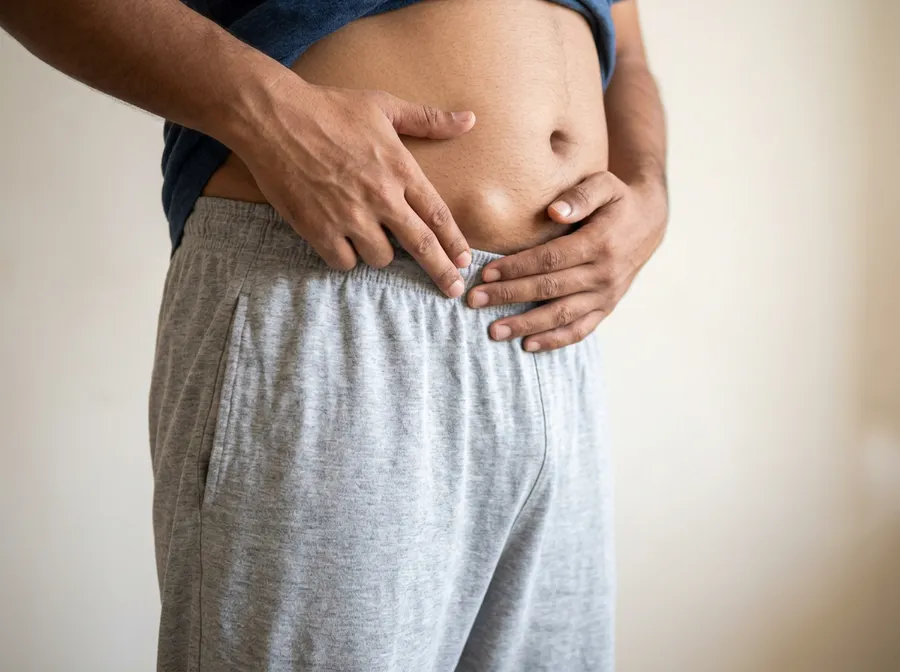
A hernia is a bulge that appears when fat or a loop of bowel pushes through a weak spot in the muscle wall of the abdomen. The weak spot may be one you were born with, one that has stretched over the years, or the scar of an earlier operation.
Most people first notice a soft lump in the groin or near the belly button. It is usually bigger when you stand, cough or lift, and it often flattens when you lie down. Many people feel a dragging ache by evening, especially after a long day on their feet or a two-wheeler ride over rough roads.
Common triggers include heavy lifting (a gas cylinder, a water can, a suitcase), a long-standing cough, straining with constipation, straining to pass urine because of an enlarged prostate, pregnancy and weight gain.
Types of hernia and how each is treated
The type of hernia decides how it is repaired. Dr. Sanjit treats all the common abdominal-wall hernias, and each has its own detailed page.
Inguinal hernia (groin)
The most common type, and far more frequent in men. A bulge appears in the groin and may extend into the scrotum, sometimes on both sides. Laparoscopic TEP or TAPP repair allows both sides to be fixed through the same small cuts.
Umbilical and paraumbilical hernia
A bulge at or just beside the belly button, common after pregnancy and with weight gain. Very small ones may be closed with stitches; larger ones usually need a mesh, placed through a small cut at the navel or laparoscopically.
Incisional and ventral hernia
A bulge through the scar of a previous operation, such as a C-section, an open appendix operation or a larger abdominal operation. These need careful planning with a CT scan, and sometimes weight loss or stopping smoking before surgery.
Recurrent hernia
A hernia that has come back after an earlier repair. Recurrent hernias are a particular focus of Dr. Sanjit's work.
Femoral and epigastric hernia
A femoral hernia sits just below the groin crease and is more common in women. It has a higher chance of getting stuck, so it is usually repaired soon after diagnosis. An epigastric hernia is a small lump in the midline above the belly button, repaired by a small open or laparoscopic operation.
Do all hernias need surgery?
A hernia does not heal on its own. Belts and exercise can ease the discomfort but do not close the gap, and most hernias slowly get bigger. You can read more in can a hernia heal without surgery?
That said, not every hernia needs an operation straight away. For men with a small inguinal hernia that causes little or no discomfort, watchful waiting is a recognised and safe option. Large studies have found the risk of such a hernia getting stuck is low. Many of these men choose surgery later, usually because the bulge grows or starts to ache, and that can be planned when it suits you.
Surgery is usually advised when the hernia:
- causes pain, aching or a dragging feeling that affects work, sleep or exercise
- is getting bigger, or no longer goes back in easily
- is a femoral hernia, or a groin hernia in a woman, because of the higher chance of trapping
- has a narrow neck, which makes trapping of bowel more likely
- has been stuck before, even once
The decision is individual. Dr. Sanjit will tell you plainly whether waiting is reasonable for you and what to watch for in the meantime.
Emergency signs: when a hernia cannot wait
Strangulation is uncommon, but it is the main reason surgeons do not leave a painful or growing hernia for years. Do not wait for a clinic appointment.
Diagnosis: what happens at the consultation
Most hernias are diagnosed by examination alone. Dr. Sanjit asks about your symptoms, your work and your activity, then examines you lying down and standing, and asks you to cough so he can feel the bulge.
An ultrasound of the abdominal wall helps when the lump is small, when the diagnosis is unclear, or when there is pain without a visible bulge. A CT scan is usually advised for incisional and recurrent hernias, so the size and number of defects can be measured before surgery.
If surgery is planned, you will have routine blood tests, an ECG and, depending on your age and health, a chest X-ray or a physician check. He walks you through the scan, the options and the recovery, so your family can plan leave and help at home.
Laparoscopic or open mesh repair?
For nearly all adult hernias, the standard repair places a mesh over the weak area. The mesh acts as a scaffold that your own tissue grows into, and studies show it lowers the chance of the hernia coming back compared with stitches alone. There are two main ways to place it.
Laparoscopic (keyhole) repair
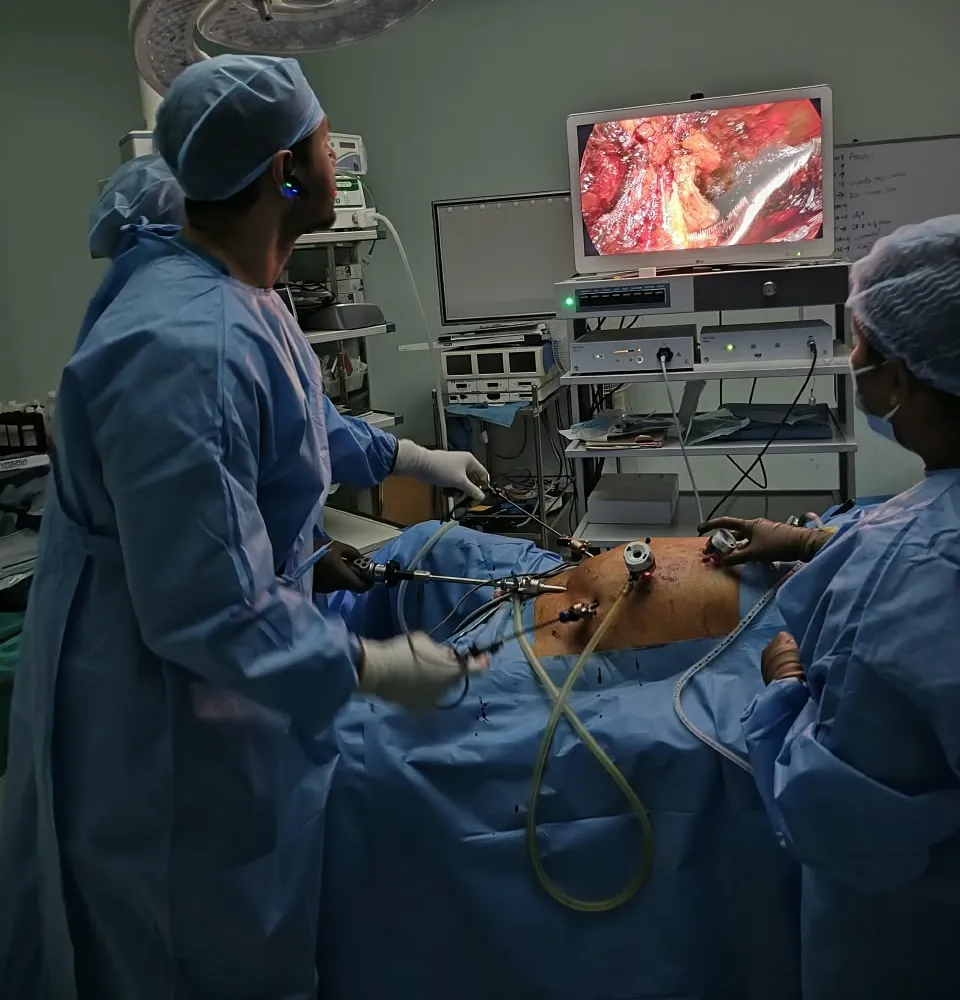
The operation is done through three small cuts of 5 to 10 mm, using a camera. For groin hernias the two main techniques are TEP (totally extraperitoneal) and TAPP (transabdominal preperitoneal). Both place the mesh behind the muscle wall, where the pressure inside the abdomen helps hold it in position. For umbilical and incisional hernias, laparoscopic IPOM places a coated mesh on the inside of the abdominal wall.
Most patients have less pain in the first weeks and return to work sooner than after open surgery, and hernias on both sides can be repaired at the same sitting. It needs general anaesthesia.
Open mesh repair
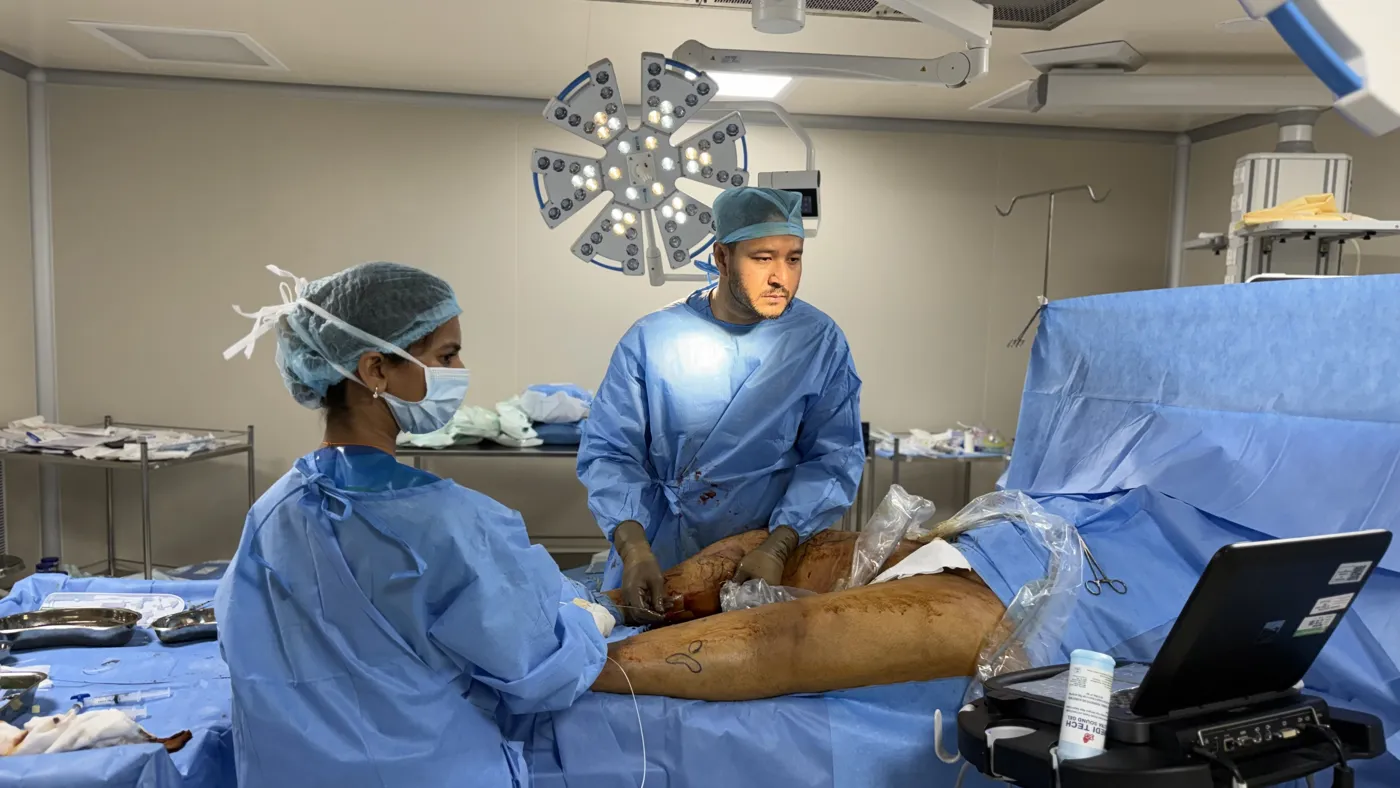
The surgeon makes a single cut of about 5 to 8 cm over the hernia and stitches a mesh in place (for groin hernias, this is the Lichtenstein repair). It can be done under spinal or local anaesthesia, which suits people for whom general anaesthesia carries more risk, and it costs less.
What Dr. Sanjit usually recommends: for most working adults, and especially for hernias on both sides, a recurrence after open repair, or a groin hernia in a woman, laparoscopic repair is usually the right fit. For an older person with heart or lung problems and a single hernia, open repair under spinal or local anaesthesia is a sound choice. The plan is always decided with you at consultation.
How laparoscopic hernia repair is done
- Admission: you come in on the day of surgery after fasting, usually for about 6 hours.
- Anaesthesia: you are asleep under general anaesthesia.
- Access: three small cuts are made, one near the belly button and two smaller ones below it.
- Repair: the hernia contents are gently returned to their place, the weak area is cleared, and a mesh is laid over it with a generous overlap. Depending on the technique it is fixed with tacks or glue, or held by the surrounding tissue.
- Closing: the small cuts are closed with dissolvable stitches or skin glue.
- Going home: most people walk within a few hours. Many go home the same evening or the next morning.
A one-sided inguinal repair typically takes about 45 to 90 minutes.
Recovery after hernia surgery
| Time after laparoscopic repair | What most patients can do |
|---|---|
| Day 0–1 | Walk, eat a light meal, pass urine; home the same day or next morning |
| Days 2–7 | Short walks several times a day, a shower as advised, pain controlled with tablets |
| Weeks 1–2 | Desk work or work from home; short drives once you can brake firmly without pain |
| Weeks 2–4 | Two-wheeler riding, light household work, gentle exercise |
| Weeks 4–6 | Heavier lifting and full exercise, as advised for your repair |
Open repair and larger incisional repairs take a little longer. Bruising and some swelling in the groin or scrotum are common and usually settle within 1–2 weeks. Drink plenty of water and eat fibre to avoid constipation, because straining in the first week is uncomfortable.
You leave with a written recovery plan, a review visit, and a direct line to Dr. Sanjit for questions while you heal.
Risks and how they are reduced
Hernia repair is safe for most people, but every operation carries some risk.
- Seroma or bruising: a fluid collection where the hernia was. It is common and usually settles on its own over a few weeks.
- Infection: uncommon. Sterile technique, an antibiotic at the time of surgery and good sugar control in diabetes reduce it.
- Long-term groin pain: studies report that roughly 1 in 10 people have some discomfort beyond three months, and only a small percentage have pain that affects daily life. Careful handling of nerves and a laparoscopic approach help lower this risk.
- Recurrence: studies report the hernia comes back in a few per cent of people after mesh repair. Correct mesh size and overlap, stopping smoking and avoiding heavy strain early all help.
- Difficulty passing urine: occasionally after anaesthesia, more often in older men, and usually short-lived.
- Injury to bowel, bladder or blood vessels: rare.
Hernia surgery cost in Bangalore
The cost depends on the approach, whether one or both sides are repaired, the type of mesh, the hospital and room category, and the length of stay. Indicative 2026 ranges, what a package usually includes and how insurance works are explained on the hernia surgery cost in Bangalore page. For an estimate for your own case, book a consultation or send your scan on WhatsApp.
Why patients from Sarjapur Road, HSR and Bellandur see Dr. Sanjit
Dr. Sanjit has about 18 years in general, laparoscopic and laser surgery and more than 6,000 procedures. He holds an MS in General Surgery and the MRCS from the Royal College of Surgeons of Edinburgh, trained DNB surgical residents at Manipal Hospital, and has mentored more than 50 young surgeons in minimal access surgery. Laparoscopic abdominal-wall hernia repair, including recurrent hernias, is central to his work. More on his background is on the about Dr. Sanjit page.
He consults and operates at SPARSH Hospital, Sarjapur Road, from 10 am to 5 pm, and sees patients at his evening clinic in Doddakannelli from 5 pm to 8 pm, Monday to Saturday. That is roughly 20 minutes from Bellandur and 25 minutes from HSR Layout, so an evening visit after an ORR workday is realistic. See directions for Sarjapur Road, HSR Layout and Bellandur.
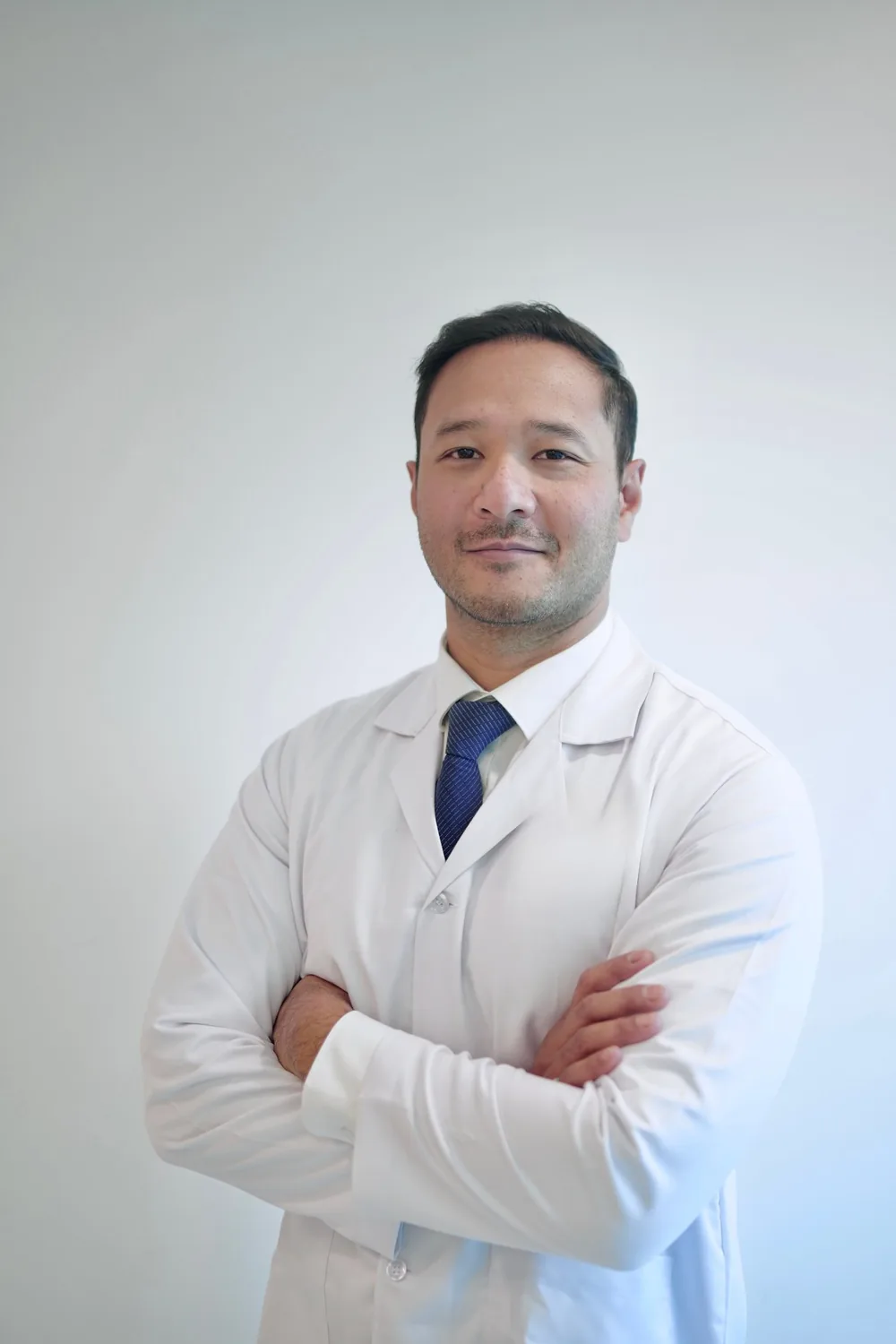
MBBS, MS (General Surgery), MRCS (Edinburgh). General and Minimal Access Surgeon with about 18 years in general, laparoscopic and laser surgery. Consults at SPARSH Hospital, Sarjapur Road (10 am – 5 pm) and his evening clinic in Doddakannelli (5 – 8 pm). KMC Reg. No. 96096. More about Dr. Sanjit